Why Large Breed Puppy Food Matters for Bergamascos
When people bring home a Bergamasco puppy, feeding often feels like one of the simplest decisions. In reality, it’s one of the more important ones, especially during the first year of growth.
For a large breed puppy like the Bergamasco, how that growth is managed early on will have a lasting impact on structure, soundness, and long term durability. Nutrition plays a direct role in that.
This is really such an important topic for me and I wanted to share this info for puppy owners.
Why large breed puppy food matters
Large breed puppy formulas are designed to support controlled growth. That may sound counterintuitive, since everyone likes to see a puppy growing quickly, but faster is not better here.
What we want is steady, consistent development. When growth happens too quickly, it can put unnecessary stress on developing joints and soft tissue.
Large breed puppy food is formulated to help regulate that growth rather than push it.
Calcium and phosphorus, and what to look for
Calcium and phosphorus are not just “important nutrients.” They are what the body uses to actually build bone, and in a growing large breed puppy, the balance between the two matters more than people realize.
For large breed puppies, most well formulated diets will fall roughly in this range:
Calcium: about 1.0% to 1.5% (dry matter)
Phosphorus: about 0.8% to 1.2% (dry matter)
Calcium to phosphorus ratio: ideally around 1.2 to 1.4 to 1
You will often see a minimum listed on the bag, but not always the maximum, which can make things a little tricky. In general, I prefer to stay toward the middle of those ranges rather than pushing the higher end.
Large breed puppies are not very good at regulating excess calcium. If too much is provided, the body will still use it, which can lead to bone developing too quickly or unevenly. When that happens, joints and soft tissue are left trying to catch up.
Phosphorus works alongside calcium, and the ratio between the two is what helps keep growth steady and coordinated. Even if the individual numbers look acceptable, if that ratio is off, development can still be affected.
This is one of the main reasons I prefer to stay with a properly formulated large breed puppy food during the main growth phase rather than trying to adjust things myself. The goal is not to maximize growth, but to guide it in a way that produces a sound, durable adult dog.
What I feed
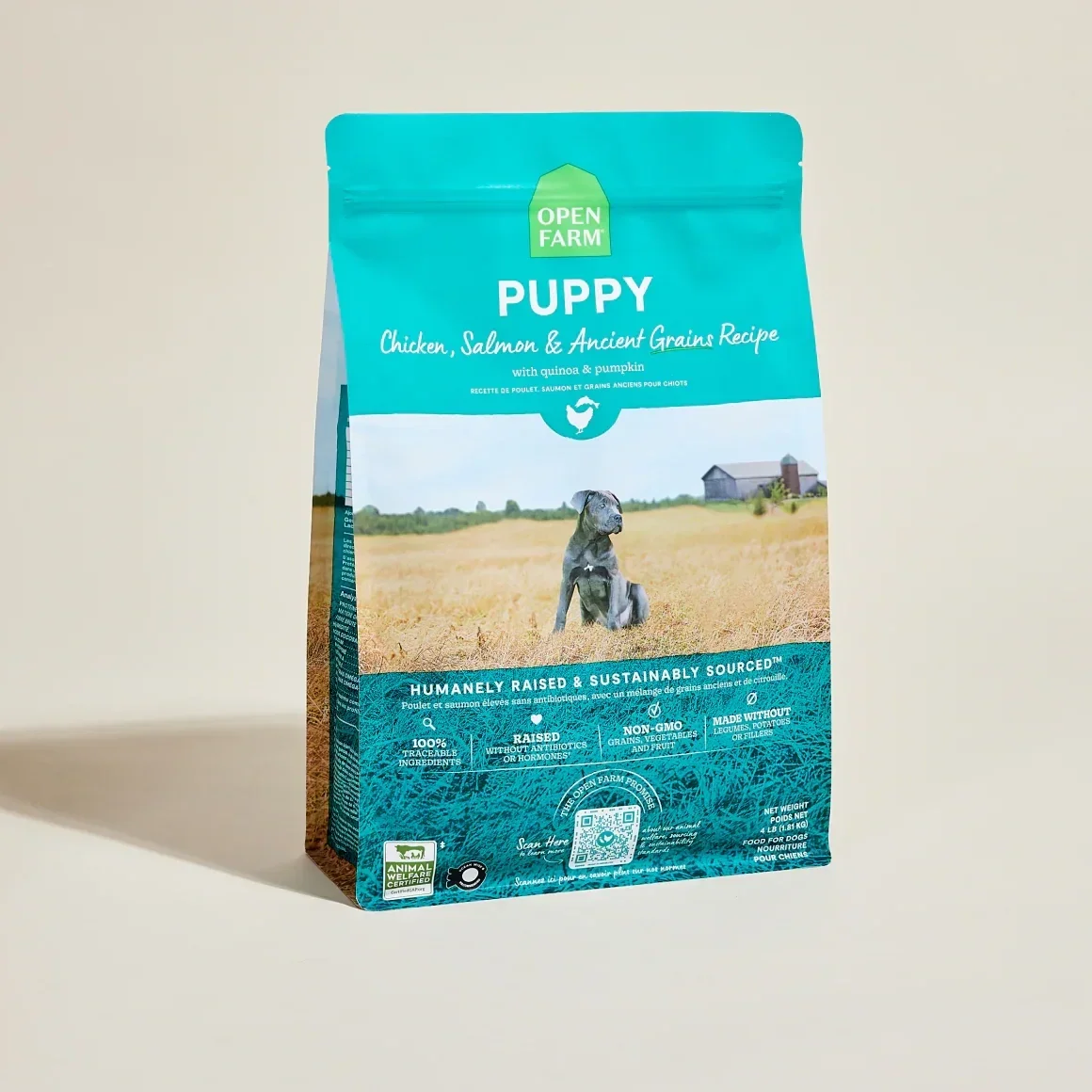
I personally use Open Farm Large Breed Puppy Ancient Grains Salmon and Chicken. I like having more than one protein source in the diet, and both options have worked well for my puppies. This is what I recommend to our puppy families.
More important than the specific brand is that the food is appropriate for a growing large breed puppy and supports steady development rather than rapid weight gain.
Calories and growth
Calories matter just as much as the nutrient profile.
Overfeeding, even with a good food, can push growth too quickly. Puppies should be kept in a lean, athletic condition rather than carrying extra weight. It is much easier to add condition later than it is to correct issues that develop from growing too fast.
I would rather see a puppy grow a little more slowly and stay balanced than shoot up quickly and struggle structurally.
How often to feed
Young puppies generally do best with multiple meals a day.
At eight to twelve weeks, three meals per day works well.
As they mature, you can transition to two meals per day.
Keeping meals consistent helps with digestion and energy levels, and it also gives you a better sense of how your puppy is doing overall.
When to transition off puppy food
I do not rush this.
Bergamascos are slow to mature, and I prefer to keep them on a large breed puppy formula longer than some other breeds. Transitioning too early to an adult food can remove some of the nutritional support needed during development.
Most of my puppies stay on puppy food until at least a year, sometimes longer depending on the individual and how they are developing.
There is no single perfect approach, but there are good guidelines that help set a puppy up for long term success. Controlled growth, proper mineral balance, and appropriate calorie intake all play a role.
This is the same approach I use when raising my own Bergamasco puppies, and it is one of the quieter pieces of the puzzle that makes a difference over time.