Bergamasco Structure: Balance Over Spectacle
I recently returned from Italy, where I spent time in Lombardy, visited breeders, looked at dogs, and found myself staring at the landscape where the Bergamasco developed. I was also there to attend the World Dog Show in Bologna, which offered a rare opportunity to see 28 Bergamascos shown in their country of origin. Breeders came from all over the world, and I was finally able to meet many people I had known only through years of online conversations. The experience was especially meaningful because the Sunday judge was one of our breed pioneers.
This post is not a critique of the dogs shown there, but rather a reflection prompted by the opportunity to see the breed, its history, its people, and its landscape together in one place. Standing there, watching the dogs in that setting, gave me a lot to think about. Not only about individual dogs, but about structure, balance, type, and where the breed may be headed in the United States.
As often happens when I travel, I came home with more thoughts than answers. Not because my opinions have changed. Most of the things I'm about to talk about are things I've been saying for years. If you've spent any amount of time talking dogs with me, you've probably heard at least some of them already. In fact, anyone who has ever made the mistake of standing next to me long enough at ringside has probably heard some version of this conversation.
The AKC ring is really what prompted me to write this. The trip to Italy simply provided another layer of perspective.
One of the structural issues I continue to notice is how often front and rear assemblies fail to complement one another. A Bergamasco absolutely needs reach. Reach that comes from a correctly constructed front assembly. It should come from shoulder layback working together with adequate upper arm length. What concerns me is that I increasingly see dogs whose reach comes more from elbow action than from the actual shoulder assembly. Many of these dogs have short upper arms. Some have upright shoulders. Some have both. At the same time, we often see rear assemblies capable of generating considerably more drive than the front assembly is capable of accepting.The result is a dog that appears busy without necessarily being efficient.
Movement should look easy. When the rear is doing more work than the front can support, the picture often becomes more hectic than harmonious. Good movement should look effortless. When a dog appears to be working excessively hard to produce motion, I often find myself looking for the structural reason why. Maybe I'm just the front assembly person. Every breeder and every judge has a thing. Some are tooth fairies, some are head people, some are tail people. Apparently I spend a good portion of my life staring at upper arms. When the front assembly is correct, a lot of other things tend to fall into place. That’s the reason why it matters so much to me.
A correctly constructed shoulder and upper arm allow the dog to carry its head and neck properly. The neck flows naturally into the withers. The withers flow into the topline. The whole front half of the dog begins to look harmonious. In many ways, when the front is right, three quarters of the dog is already headed in the right direction. Of course, the rear assembly is another discussion entirely, and it still needs to match what is happening in front. But when I evaluate my own puppies and my adult dogs, I often find myself starting at the shoulder because so much of the breed's overall picture originates there. A restricted front frequently creates a chain reaction. Head carriage changes. Neck carriage changes. The chest changes.The transition into the withers changes. The silhouette changes. The movement changes. Conversely, when I see a Bergamasco with a correctly assembled front, I often find myself liking the rest of the dog as well. Not always, but often enough that I keep coming back to the same place.
All of these are true:
A straight front and straight rear can be balanced.
A moderately angulated front and rear can be balanced.
A more angulated dog can be balanced.
The amount of angle matters less to me than whether the pieces fit together, but that does not mean extremes are equally useful. What bothers me most is imbalance: a good rear paired with a short upper arm, a laid-back shoulder paired with a rear that cannot support it, or any construction that produces motion without efficiency.
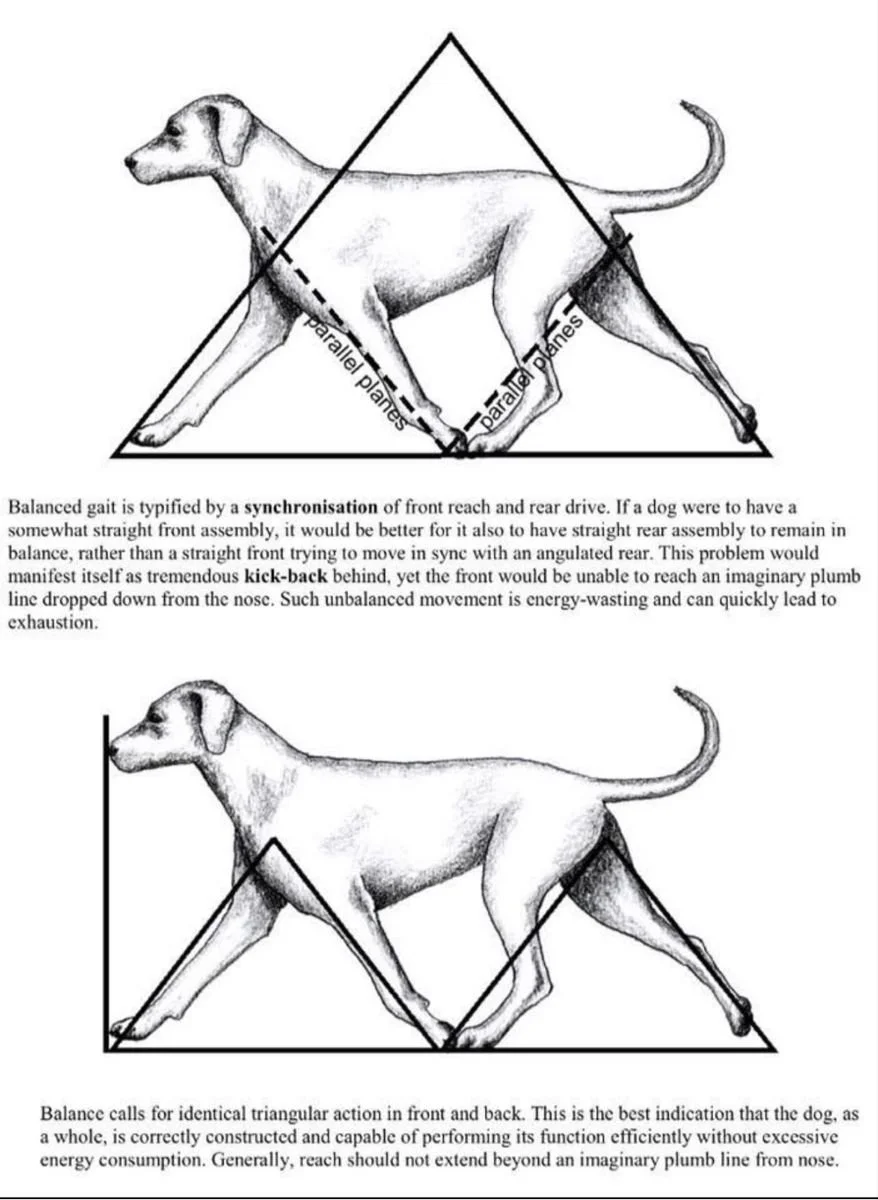
This diagram is not meant to represent Bergamasco breed type or proportions. I’m only using it to show the general concept of balanced side gait: the front and rear should match in timing and efficiency. Correct movement is not about exaggerated reach or dramatic kick behind, but about a dog that covers ground smoothly without wasted motion.
The older I get, the less interested I become in individual parts and the more interested I become in how those parts work together. This is where I often find myself comparing modern Bergamascos to German Shepherd Dogs, and usually getting myself into trouble.To be clear, I am not criticizing German Shepherds.A well-constructed German Shepherd is a sight to behold and possesses tremendous reach in front. The issue is not the reach. The issue is that the Bergamasco was developed for a different purpose. They should not look the same.The Bergamasco was never intended to be a flying trotter.
While driving through the pre-Alps of Bergamo and the surrounding areas of Lombardia, I kept thinking the same thing:
Nothing here is flat.
Now, I certainly don't pretend to be an expert on the region. Still, what struck me was the terrain itself. Hills and mountains seemed to be everywhere. Roads twisted and climbed and villages sat on slopes. The landscape felt demanding. Looking at it, I found myself thinking less about side gait and more about balance, agility, endurance, and athleticism. A dog helping manage hundreds of sheep during transhumance is not simply trotting around all day. At some point that dog is running, galloping. At some point that dog is climbing somewhere you and I would rather not. The more I think about it, the more I believe we sometimes place too much emphasis on the trot when evaluating Bergamascos.The breed certainly needed an efficient trot, but it also needed to be an athlete.
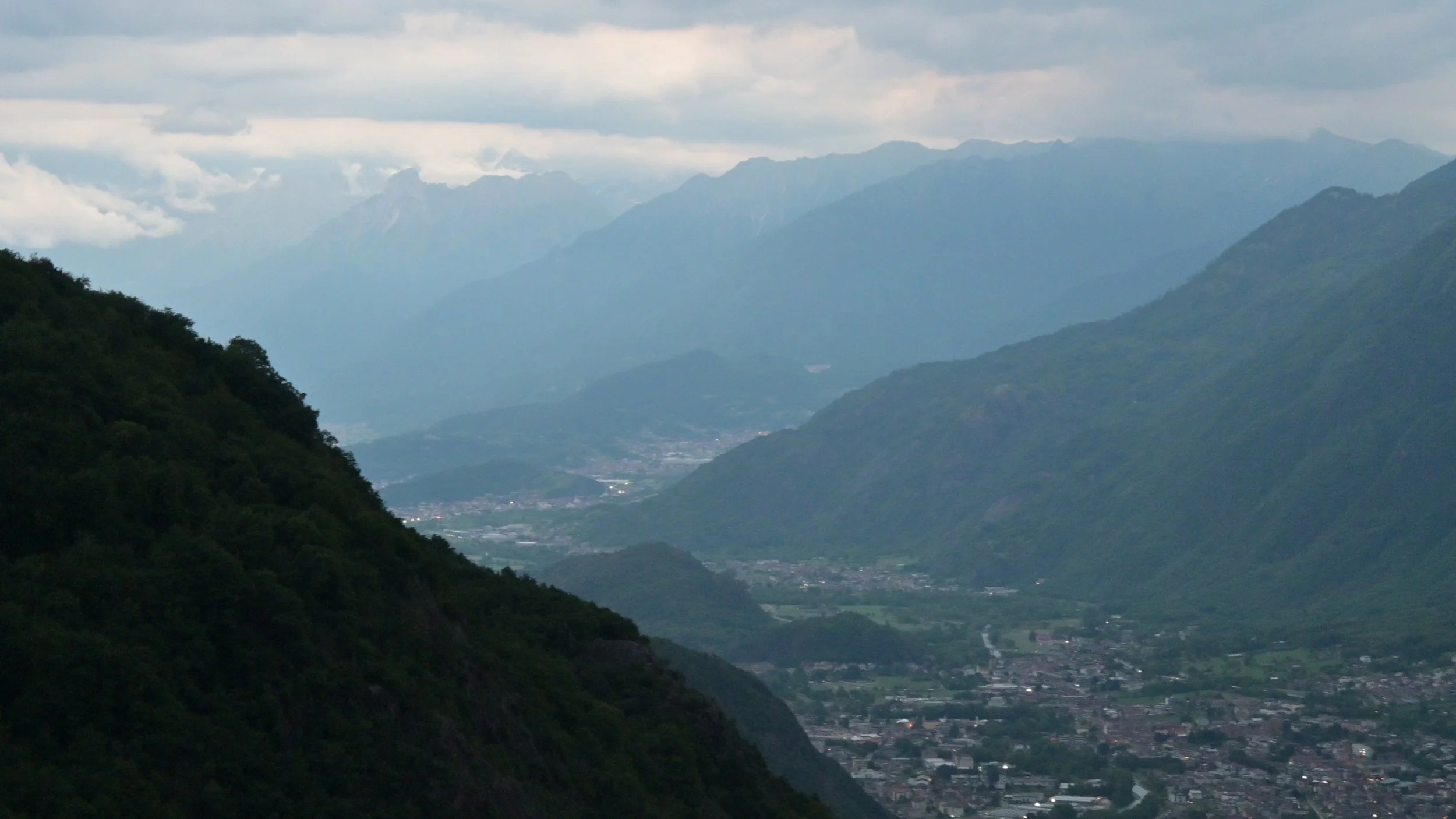
A photo from the car outside of Bergamo, Italy. Pre-Alps.
One misconception is that concern over these issues is a call for straighter dogs. It isn't. A Bergamasco still requires a functional front assembly capable of true reach, and the rear must complement what is happening in front. Balance matters, it always will. At the same time, I don't believe balance alone is the answer. The Bergamasco was developed as an athletic shepherd, and for that reason I find myself drawn to moderation. A dog can be balanced across a range of angulation, but not every balanced dog necessarily reflects the type of athlete I believe the breed was intended to be. When I think about a Bergamasco working difficult terrain, helping manage sheep, climbing, turning, accelerating, and galloping when necessary, I find myself favoring dogs that look capable of doing those things with ease. For me, that means balance, but it also means avoiding exaggeration.
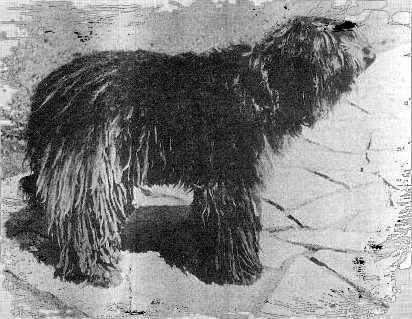
Alpino Di Valle Imagna 1949
One of the things that has always struck me while revisiting old photographs was how moderate many historical Bergamascos appear. Take Alpino Di Valle Imagna, the dog upon which much of the modern Italian standard was based in 1949. None of us can evaluate movement from a picture taken seventy years ago, but still, I find it interesting what I don't see. I don't see exaggerated angulation or a dog built around producing the largest possible side gait. I see a square, compact, sturdy, athletic shepherd. Most importantly, when I look at those photographs and then look at the landscape where the breed developed, the dog makes sense.
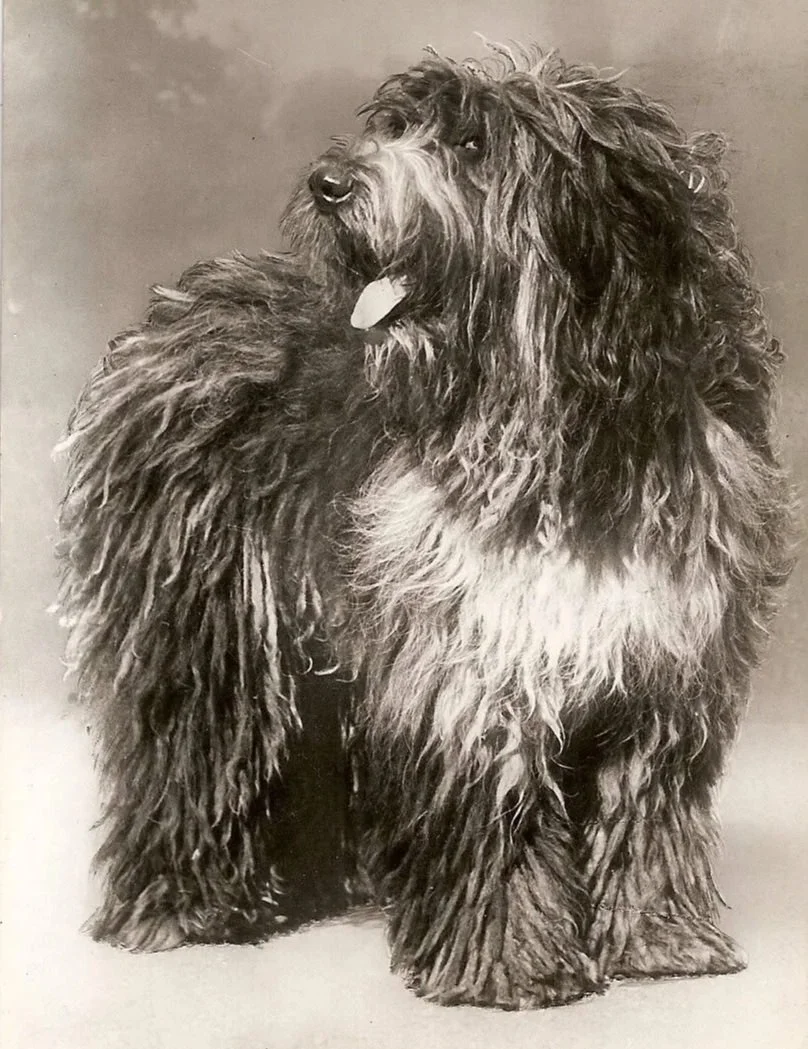
Alpino. The dog on which the original standard was based.
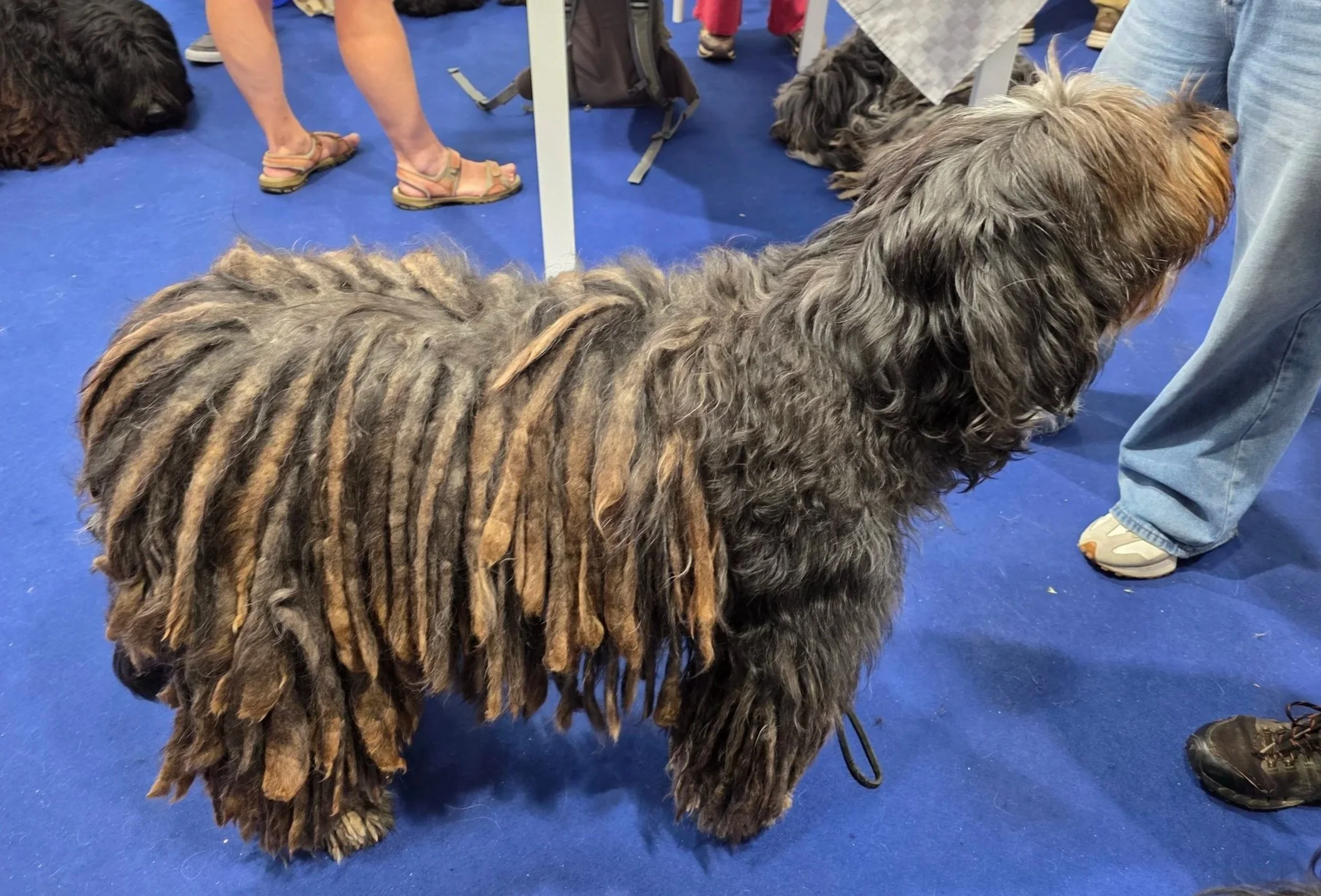
Bergamasco in Italy at World Dog Show 2026 with correct coat distribution ( doppio pelo)
The same thoughts apply to coat. In Italy I still saw plenty of examples of what Italians call doppio pelo ( meaning double coat rather than the triple coat that causes the flocks to form). This is the smoother, harsher goat hair extending over much of the front assembly before transitioning into flocks farther back. This coat makes sense. We see it here in the U.S.A but not nearly enough. In all my years of breeding we have produced maybe 4 dogs that truly have this coat. Not a coat that is groomed to look like this, but the real unmaintained version. It was common in Italy among the dogs I saw. A correct distribution of hair leaves much of the front half of the dog covered in harsher goat hair while the flocking develops farther back. In many cases, the entire front half of the dog remains virtually maintenance free. The coat protects the dog, performs its job, and doesn't require constant intervention from the owner.
Heavy coat has become fashionable, and I am hardly innocent here. I have certainly shown dogs carrying plenty of coat myself. We all respond, at least to some degree, to what gets rewarded. More importantly, however, in a rare breed you can only work with the dogs available to you. When Bergamascos first arrived in the United States in the early 1990s, the priorities were different. The breed population was extremely small, and establishing a viable gene pool was far more important than refining coat texture or coat distribution. Breeders were focused on preserving and expanding a rare breed with very limited numbers. As a result, the coat characteristics that many of us discuss today were not necessarily at the forefront of breeding decisions. The dogs that became the foundation of the breed in this country tended to carry heavier coats, and that look gradually became familiar to breeders, exhibitors, judges, and the public alike. At the same time, the early AKC breed standard was based on a translation that, while generally describing the correct coat, left room for interpretation. Understanding the coat described in the standard often required connecting pieces of information from multiple sources, and coat structure was not emphasized as heavily in early judges' education as it is today. Judges can only evaluate the dogs they see, and the first Bergamascos presented in the United States became the reference point for what many considered typical. Over time, those impressions naturally became established within the breed. None of this means that coat is the most important aspect of a Bergamasco. It isn't. Structure, temperament, movement, and overall breed type will always matter more. But when all of those pieces come together, I appreciate seeing the correct coat as well. My hope is simply that a correct, functional coat is not overlooked because it lacks the dramatic appearance that has become familiar in the show ring.
But I do think it is worth remembering that the Bergamasco is a shepherd first and a decorative throw rug second.
I also want to emphasize that none of this should be interpreted as a discussion about which dogs should or should not be bred. That isn't the point. Every Bergamasco has strengths. Every Bergamasco has weaknesses. If breeding were only about perfect dogs, none of us would be breeding. What I am describing are trends I believe are becoming increasingly common in the breed and the direction I personally would like to see us move. For me, that means greater emphasis on balance, correct assembly, efficiency of movement, and preserving the characteristics that make the Bergamasco unique.
Breeding is rarely about finding perfection. More often, it is about identifying strengths, recognizing weaknesses, and making thoughtful decisions about the next generation. At the end of the day, these are simply some observations that I keep coming back to after twenty-two years in the breed. The older I get, the less interested I become in spectacular parts and the more interested I become in how those parts work together.
After so many years in the breed, I am less interested in how much angle a dog has, how much coat it carries, or how dramatic it appears moving around a show ring. What interests me is whether the pieces fit together. When the pieces come together, the dog rarely needs to demand your attention.